
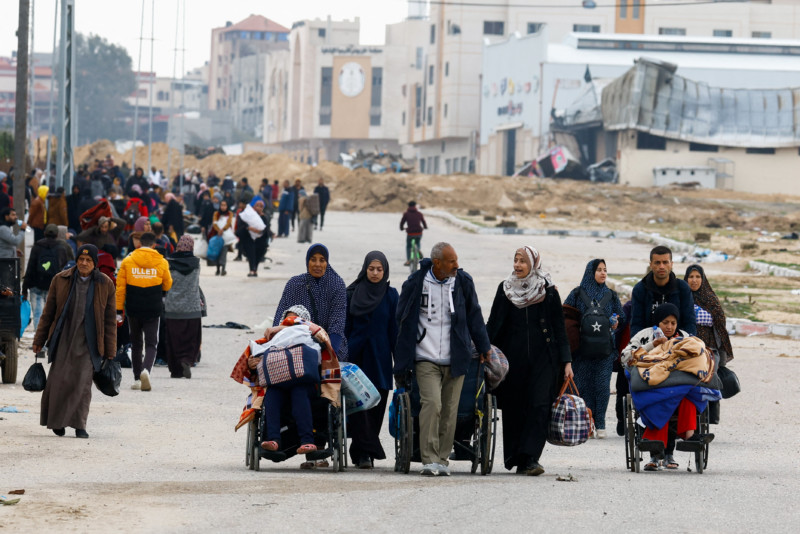
The sweltering heat of August 2025 has brought with it a silence that is heavier than the sound of any explosion. It is the silence of a Gaza that has finally been pushed past the point of “coping” or “resilience”—words the international community has leaned on for nearly two years to avoid using the word “collapse.” But here we are, in the final days of August, and the technical reports have finally caught up to the reality on the ground. When the Integrated Food Security Phase Classification officially moved the Gaza Governorate into Phase 5—the Famine category—on August 22, it wasn’t just a change in a spreadsheet. It was a formal admission that the world has watched a population of two million people reach the biological limit of human endurance. To understand what is happening right now, you have to look past the political grandstanding and into the actual mechanics of a society that is being erased, not just by fire, but by the slow, agonizing depletion of everything a human being needs to stay alive.
There is a specific kind of horror in the way a famine unfolds in the modern age, captured in high-definition satellite imagery and detailed calorie-count spreadsheets, yet allowed to continue nonetheless. In the first three weeks of this month, the data suggests that over 132,000 children under the age of five are living in a state of acute malnutrition. To say they are “hungry” is a profound understatement that borders on an insult. In the makeshift clinics that remain in the north, doctors are seeing children whose skin has lost its elasticity, whose hair is turning a brittle, rust-colored hue because of protein deficiency, and whose hearts are literally thinning as the body begins to consume its own muscle tissue for energy. About 41,000 of these children are in the “severe” category, meaning they are at a point of no return where even a sudden influx of food could kill them through refeeding syndrome. They need specialized medical stabilization that simply does not exist anymore. This is the human rights crisis of our century: a generation of children being physically and neurologically stunted because of a calculated restriction on the entry of basic sustenance.
The mortality statistics for August 2025 tell a story of a shift in the nature of death. For the first year of this conflict, the majority of the tens of thousands of casualties were the result of direct trauma—airstrikes, shelling, and small arms fire. But this month, the “excess deaths” from non-kinetic causes have surged to nearly half of the total monthly fatalities. With the official death toll now climbing past 62,000, we are seeing an average of 119 people dying every single day. Many of these people are not dying from bombs; they are dying because they ran out of insulin three weeks ago, or because their kidneys failed and there was no fuel for the dialysis machines, or because they drank water from a contaminated well and their malnourished bodies couldn’t fight off the resulting infection. It is a slow-motion mass casualty event that happens in the shadows of the ruins, away from the cameras, in the corners of overcrowded tents where parents watch their children fade away.
The infrastructure of life has been so thoroughly dismantled that the very concept of a “right to health” has become a cruel joke. Only about 38% of the primary health facilities in the entire Strip are even minimally functional, and “functional” here means they have a roof and perhaps some clean bandages. They are operating without consistent electricity, without sterile surgical tools, and without even the most basic pain medication. For the 55,000 pregnant women currently in Gaza, August has been a month of unimaginable terror. The miscarriage rate has skyrocketed by 300% since the start of the crisis. Women are giving birth in the middle of displacement camps, on dirt floors, with no clean water to wash the newborn. If the baby survives the birth, the mother—likely starving herself—often cannot produce enough milk, and the lack of clean water makes infant formula a deadly gamble. We are witnessing the systematic destruction of the beginning of life, a direct violation of the most fundamental human right to exist.
Water has become the most precious and most dangerous commodity in the Strip. In this August heat, the average person is surviving on less than five liters of water a day. To put that in perspective, the global minimum for basic survival in a disaster is fifteen liters. Those five liters must be split between drinking, cooking, and the hygiene necessary to prevent the spread of disease. But even that water is rarely clean. With 70% of the sewage pumping stations destroyed and the treatment plants offline, raw sewage is flowing through the streets and pooling in the low-lying areas where people have been told to seek “safety.” In the first half of August alone, there were over 40,000 recorded cases of acute watery diarrhea. In a healthy person, this is a nuisance; in a starving child, it is a death sentence. The dehydration happens so fast that by the time a parent realizes the danger, the child is often too far gone to be saved.
There is also the matter of what sociologists call “urbicide”—the literal killing of a city. This isn’t just about destroying military targets; it is about destroying the “connective tissue” that allows a society to function. About 80% of all buildings in Gaza are now damaged or destroyed. This includes the bakeries that fed neighborhoods, the markets where families traded, the courthouses that held records of property and birth, and the municipal archives that contained the history of the people. When you destroy the physical environment of a people, you are attempting to erase their future and make the land uninhabitable for generations to come. This is closely followed by “scholasticide,” the total destruction of the educational system. With every single university leveled and 87% of schools gone, the right to education has been revoked for every child in Gaza. This ensures that even if a ceasefire is reached tomorrow, the wounds of this conflict will bleed for decades as an entire generation grows up without the tools to rebuild their world.
The legal reality of August 2025 is that the world is documenting a war crime in real-time. International law, specifically the Rome Statute, is very clear that the intentional starvation of a civilian population as a method of warfare is a crime against humanity. The famine declaration is the evidence. The humanitarian aid that sits in trucks at the border, denied entry because of “dual-use” labels on things as simple as water pipes or medical oxygen, is the evidence. The obligation of an occupying power or a belligerent force to ensure the basic needs of a civilian population is not a suggestion; it is a binding legal duty that has been systematically ignored. By mid-August, the amount of aid entering the Strip dropped to its lowest level since the early days of 2024, despite the fact that the needs of the population have quadrupled as their personal reserves have been completely exhausted.
Behind the numbers, there is the psychological toll, which is perhaps the most difficult thing to quantify but the most pervasive. Over a million children are living in a state of constant, toxic stress. They have lost their homes, their schools, and in many cases, their entire extended families. The physical sensation of hunger, the constant buzzing of drones overhead, and the sight of their parents’ helplessness creates a trauma that rewires the brain. We are looking at a society where the traditional family structures have been shattered by the sheer desperation of survival. When a father has to choose which child gets the last piece of bread, or a mother has to sell her last wedding ring for a gallon of dirty water, the spirit of a community is put under a pressure that no human being was ever designed to withstand.
As we move toward the end of August 2025, the plea from the human rights community is no longer for “managed” aid or “temporary pauses.” Those measures have proven to be woefully inadequate. What is needed is a total and immediate restoration of the basic requirements for life. This means a permanent ceasefire to stop the dying, but it also means the immediate repair of power lines to get water plants running again, the opening of every single border crossing for a massive, unimpeded “flood” of aid, and a global medical intervention to treat a starving population. The famine of August 2025 was not a natural disaster. It wasn’t a drought or a crop failure. It was a man-made catastrophe created by policy, maintained by blockade, and allowed by international indifference.
History will look back at this month as a definitive marker. It will be remembered as the time when the technical thresholds for famine were met and the world’s “never again” was tested and found wanting. The data we see today isn’t just a warning anymore; it’s a ledger of a realized tragedy. Every day that passes without a massive shift in the status quo adds more names to the list of those who died not from a bullet, but from the simple, agonizing lack of bread and water. The tragedy of Gaza in August 2025 is that we know exactly how many people are dying, we know exactly why they are dying, and we have the food and medicine to save them sitting just a few miles away behind a fence. The failure to bridge that gap is the ultimate human rights failure of our time.
The images coming out of the north this week are haunting—families boiling weeds to make a bitter soup, children digging through the dirt for any scrap of discarded food, and the elderly simply lying down in their tents and waiting for the end because they no longer have the strength to stand in line for aid that may never come. There is a profound exhaustion in the voices of the humanitarian workers who remain. They are tired of writing reports that no one acts on; they are tired of counting the dead when they should be saving the living. They describe a sense of abandonment that is absolute. To them, and to the people of Gaza, the international laws we talk about in air-conditioned rooms in Geneva or New York feel like a cruel fiction.
In the end, the story of August 2025 is a story of thresholds. We crossed the threshold of famine, we crossed the threshold of healthcare collapse, and we crossed the threshold of a generational loss of education. But the most dangerous threshold we have crossed is the one of normalization—the point where the world becomes accustomed to the sight of a starving population and treats it as an intractable problem rather than an urgent, solvable crime. As the sun sets on another day in Gaza, tens of thousands of parents are tucking their children into beds of rubble or sand, knowing that they have nothing to give them when they wake up hungry in the morning. That is the reality of the August nadir. It is a reality that demands more than our sympathy; it demands an immediate and total reversal of the policies that brought us to this edge. If we do not act now, the silence of August will become the permanent legacy of our era, a testament to what happens when humanity decides that some lives are simply not worth the effort of saving.
We must also confront the reality of what “recovery” would even look like from this point. Even if the war ended tonight, the famine of August 2025 has already left its mark. The physical stunting of children, the psychological scarring of survivors, and the total destruction of the environment mean that Gaza will be a land of trauma for the next fifty years. You cannot simply “rebuild” a society that has been dismantled at the cellular level. The work of the coming years will not just be about laying bricks and mortar, but about attempting to restore a sense of safety and dignity to a people who have been told, through twenty-two months of bombardment and starvation, that their lives do not matter. This is the weight of what has been lost this month. It is a loss that belongs to all of us, because every time a human right is systematically extinguished without a global outcry, the rights of every person on this planet become a little bit more fragile. August 2025 is not just Gaza’s darkest hour; it is a dark hour for the very idea of a shared humanity.
In Gaza, every second is a calculation of survival. While the politics remain stalled, the need for clean water, medical supplies, and shelter is immediate and undeniable. You don’t have to wait for a ceasefire to save a life. Donate what you can to the UNRWA (United Nations Relief and Works Agency for Palestine Refugees in the Near East) today. (https://donate.unrwa.org/int/en/)