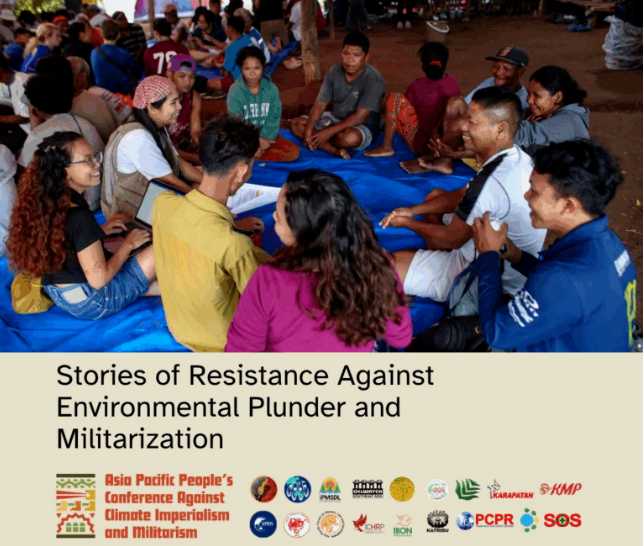
Quezon City, Philippines – Just days before the Asia Pacific People’s Congerence Against Climate Imperialism and Militarism, a powerful act of solidarity will unfold across some of the archipelago’s most besieged landscapes. Grounding Solidarity, the conference’s prelude, is not just another academic gathering – it’s a journey into heart of resistance. Researchers, journalists, human rights defenders,environmental advocates and scholars will step off conference halls and into communities on the frontlines – where rising seas meet militarized borders and where forests are not just ecosystems, but homelands under siege.
For over a decade, the Philippines has held a grim distinction: the deadliest country in Asia for environmental defenders. That’s not an exaggeration – it’s documented reality. According to Global Witness, year after year, the nation tops the list. Behind these killings? Too often, it’s not armed rebels or criminal syndicates. It’s the very institutions meant to protect: the Armed Forces of the Philippines (AFP) and the Philippine National police (PNP), as confirmed by local watchdog Kalikasan. These forces, operating under the banner of “national security”, continue to target those who stand between profit-driven projects and the land, water and people they endanger.
From ancestral domains to protected forests, state violence shadows climate defense. Large-scale mining, land grabs for so-called “development”, and extractive industries flourish – fueled by corruption and backed by military boots. Meanwhile, communities face a double catastrophe: the ravages of a climate crisis worsened by these same industries, and the repression that follows when they resist. Displacement. Food insecurity. Ecological collapse. And when people speak up, they’re branded “insurgents”. When they organize, they’re surveilled. When they lead, they’re disappeared, or killed.
In Southern Tagalog, the wounds of the 2021 Bloody Sunday Massacre remain open. Four indigenous defenders and two coastal conservationists were among those slain – by state forces – during protests against megadams and ecotourism projects that threaten ancestral lands.The region still echoes with demands for justice, met only by silence and continued surveillance.
On Mindoro Island, the Mangyan people face a cruel paradox: their mountains, rich in critical minerals, are being auctioned doff as “green energy solutions”. But this “clean” transition comes with bombs, strafing runs and forced relocations – military tactics disguised as peacekeeping. When Mangyan student Jay-el Maligday was gunned down in 2024 and falsely labelled a rebel, it wasn’t an isolated tragedy. It was a pattern of silencing dissent by calling it insurgency.
In Negros, the legacy of feudal haciendas lives on – not through tradition, but through violence. The AFP acts as private security for powerful landowners, crushing community resistance with military drills and massacres. The message is clear: dissent will be met with bullets.
And in Leyte, where Super Typhoon Yolanda (Haiyan) left scars that still haven’t healed, people are still fighting – not just for recovery, but for dignity. They’re demanding real disaster preparedness, not more destructive mining, dredging and infrastructure that pushes them further from home.
“In a country that treats farmers and the marginalized like enemies” says Danilo Ramos of Kilusang Magbubukid ng Pilipinas (KMP), “standing up is not rebellion – it’s survival. We’re not the threat. State terrorism is. The massacres – the Bloody Sunday killings, Escalanmte, Himamaylan – these are their crimes”.
The truth is undeniable, syas Jonila Castro of Kalikasan “The Philippines is ground zero – for the climate crisis and for the resistance against it”.
Grounding Solidarity is more than observation. It’s immersion. Delegates will travel deep into the Sierra Madre, across Mindoro, Negros and Leyte – listening, learning and bearing witness. Through people’s assemblies, community dialogues and lived experiences, they will gather stories not meant for glossy reports but for reckoning. The mission will culminate in a public report-back, where the voices of the silenced will be amplified- on national and international stages.
“We cannot afford to be passive” says Rchelle Junsay of Peoples’s Rising for Climate Justice. “When power destroys our planet,we must rise – collectively, fiercely, across borders and borders. From the village to the global stage, our resistance must be everywhere.”
This is where journalism becomes justice. Media partners are invited to cover the launch of the mission and the final press briefing in Manila. On-the-ground reporting – raw, unfiltered, human-centered – can bridge the gap between local struggle and regional resistance, exposing the machinery of climate imperialism and militarized control.
These are not abstract issues. They are lies. They are land. They are the future. And they are fighting back.
You can play your part as citizen journalists. Your identity is a shield; your information is a weapon. If you have witnessed corruption or human rights abuses, CAHRE’s secure channel ensures your voice is heard without putting your safety at risk.